
Major laggards among Sensex constituents included Bharti Airtel, Hindustan Unilever, Tata Steel and ITC. Power Grid, UltraTech Cement, NTPC and Titan emerged as winners.

Indian benchmark indices, Sensex and Nifty, closed almost flat in choppy trade as investors remained cautious due to ongoing uncertainty in West Asia, relentless foreign fund outflows, and anticipation of the RBI's monetary policy decision.

The Indian rupee weakened against the US dollar due to geopolitical tensions surrounding the Strait of Hormuz and ahead of the Reserve Bank of India's monetary policy review.

'We never waste a crisis. There will be learning and the supervisory tools will get better with each episode.'

The Indian equity market is set for an event-heavy week, with analysts pointing to the Reserve Bank of India's (RBI) interest rate decision, developments in the US-Iran situation, and crude oil prices as the primary determinants of market trends.

Indian stock market benchmarks, Sensex and Nifty, saw gains in early trading, driven by anticipation surrounding the Reserve Bank of India's monetary policy decision, despite mixed global cues and significant FII outflows.

The RBI is fully aware that the high-cost loans and high indebtedness of the borrowers could pose financial stability risks, if not addressed by these NBFCs. Governor Shaktikanta Das has issued a stern warning, saying the RBI is closely monitoring these areas and will not hesitate to take appropriate action, if necessary, if the culprits don't opt for self-correction. Watch out for some action, soon, notes Tamal Bandyopadhyay.

The Indian stock market is poised for a volatile week, influenced by the Reserve Bank of India's monetary policy decision, crucial global macroeconomic data, and the escalating geopolitical tensions in West Asia, according to market analysts.

Gold prices are expected to maintain their upward momentum though some consolidation could set in ahead of the US Federal Reserve's policy decision on September 17, analysts said. Traders will focus on the trade inflation data to gauge the impact of tariffs, inflation numbers from major economies including UK and Euro zone, along with monetary policy meetings of Bank of England and Bank of Japan which will provide more guidance for bullion prices, they added.

The Reserve Bank of India (RBI) has kept its key lending rate, the repo rate, unchanged at 5.25 per cent for the second consecutive time, citing concerns over rising energy prices, supply disruptions from the West Asia crisis, and potential inflationary pressures.

Most members of the Reserve Bank of India's Monetary Policy Committee (MPC) expressed concerns about inflation becoming generalised and highlighted uncertainties surrounding both inflation and growth prospects due to the West Asia conflict, according to the recently released minutes.

Indian benchmark indices Sensex and Nifty closed marginally lower due to profit-taking, following the Reserve Bank of India's decision to keep the repo rate unchanged while lowering its growth expectations for the current fiscal year and forecasting higher inflation.
Uncertainties stemming from the West Asia crisis and its potential impact on inflation and economic growth were key factors in the Reserve Bank of India's Monetary Policy Committee (MPC) decision to maintain the status quo on interest rates, according to the recently released MPC meeting minutes.

This time the all-powerful interest-rate setting panel, whose constitution was notified by the government on Thursday, will take call on interest rate. But that's not the only change. The Reserve Bank of India has also decided to change the timing of announcement of its policy review, due next Tuesday, to mid-afternoon.
The Reserve Bank of India (RBI) on Friday kept key repo rate unchanged at 4 per cent in view of rising inflation and faint signs of economic growth amid gradual lifting of coronavirus (COVID-19) lockdown. The central bank's newly-constituted monetary policy committee (MPC) began its three-day meeting on October 7 and maintained the stance as accommodative. It also kept the reverse repo rate unchanged at 3.35 per cent.

'The MPC is likely to prioritise the key mandate, which is inflation, while relying on other instruments to stabilise the currency and bond markets.'

India's wholesale price inflation (WPI) increased to 9.87 per cent in June, up from 9.68 per cent in May, primarily due to significant price increases in non-food and food products, with food inflation alone rising to 5.49 per cent.

New dates to be announced shortly, the RBI said.

Markets will look for clear guidance on how the MPC interprets the uncertainty and what it implies for the future course of monetary policy, points out Rajeswari Sengupta.
The Reserve Bank of India (RBI) has opted to keep its key interest rates unchanged at 5.25%, anticipating a global economic recovery following a ceasefire in the US/Israel-Iran conflict, despite ongoing inflationary pressures and currency fluctuations.
Remarks come at a time when he is under pressure from the govt to cut interest rates.

From the Sensex pack, Power Grid, Mahindra & Mahindra, JSW Steel, HCL Technologies, Sun Pharma, Nestle, IndusInd Bank, Reliance Industries, Bharti Airtel and ITC were the major laggards. Tech Mahindra, Wipro, Bajaj Finance, State Bank of India, Bajaj Finserv, Axis Bank, Titan and ICICI Bank were among the major gainers.

Reducing policy rates is not enough. The key is to ensure banks lend to credit-constrained borrowers.

The Lok Sabha elections in 2024 are not a consideration when it comes to monetary policymaking, said Reserve Bank of India governor Shaktikanta Das to underscore the central bank's commitment to controlling inflation. "It's not possible for me to comment what we do in the next MPC (Monetary Policy Committee), but one thing I can tell and I would like to make it very clear-that the fact of elections coming up in 2024 is not a factor at all so far as monetary policymaking is concerned. "Monetary policymaking is for checking (and) controlling inflation," Das said at the Business Standard, BFSI Insight Summit.

FPIs have already withdrawn Rs 2.6 trillion from Indian equities in 2026, exceeding the outflows recorded in any previous full calendar year.

rediffGURU Vipul Bhavsar answers readers' personal income tax queries

Of the seven members, four are proposed to be government nominees and the rest from RBI.

Reserve Bank of India (RBI) Governor Sanjay Malhotra stated that recent regulatory measures to address foreign exchange market volatility, such as capping banks' net open positions, are temporary and aligned with current market conditions, not signalling any structural shift in policy.

"It is heartening to note that the RBI has chosen growth over monetary tightening and inflationary fears," FICCI president Harsh Pati Singhania said.

The Indian rupee saw a significant appreciation against the US dollar following President Trump's suspension of military strikes against Iran and the Reserve Bank of India's decision to maintain its key interest rate. Market sentiment was further buoyed by positive comments from the RBI regarding the health of the banking sector.
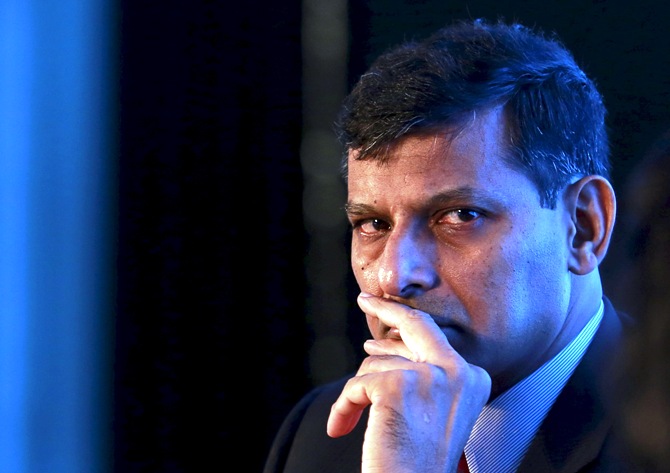
The policy will be presented in the backdrop of rising inflation.

Bank of Baroda economists project India's GDP to grow 6.5-6.8 per cent in FY27 but warn that the fiscal deficit could overshoot the budgeted 4.3 per cent target, potentially reaching 4.7-4.8 per cent of GDP due to subsidy overruns, excise duty cuts, and oil marketing company losses.

State Bank of India Chairman C S Setty has expressed support for a 'pause' in policy rates by the Reserve Bank of India's monetary policy committee, believing it will help stabilise conditions and support economic growth. He also urged investors to look beyond short-term equity market movements and focus on India's structural transformation, driven by reforms and digital infrastructure.
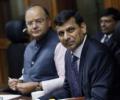
RBI Governor Raghuram Rajan has been pursuing hawkish monetary policy stance to keep inflation under check.

'If the war continue for a longer period of time, it is just a matter of time before the government will pass on some of the price increases.'

The US Fed's interest rate decision will be the major factor dictating trends in the domestic equity market this week, with global movements and foreign investor activity also influencing sentiment, according to analysts. Stock markets ended the last week on a subdued note, with benchmark indices Sensex and Nifty closing flat.

The RBI has hiked repo or short-term lending rate up by 0.25 pc to 7.75 pc.

Indian markets on Dalal Street rallied sharply as easing tensions in the US-Iran conflict and stable oil prices boosted sentiment. Track Nifty 50 and BSE Sensex performance and key global triggers.

The consumer price index (CPI)-based inflation hitting an all-time low in October would encourage the six-member monetary policy committee (MPC) of the Reserve Bank of India (RBI) to cut the policy repo rate in its upcoming December 3-5 meeting. However, the July-September GDP growth, expected to be above 7 per cent, may act as a deterrent.

Former Reserve Bank Governors do not seen any harm in central bank consulting the government before firming up monetary policy initiatives saying such an step would not amount to infringement on its independence.
